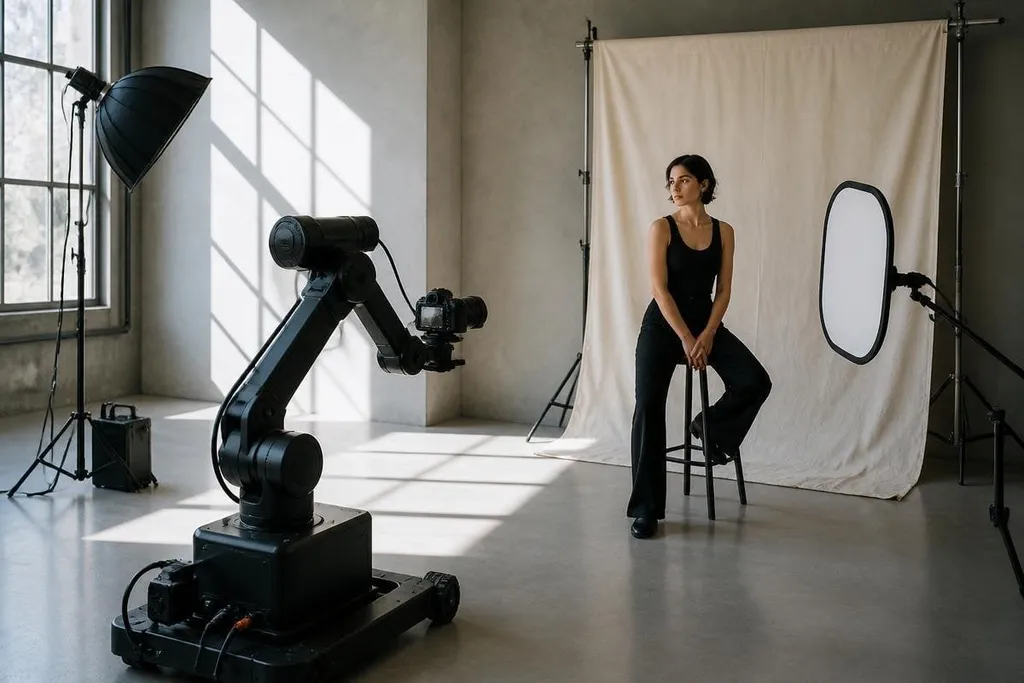
A photography robot may spend less time pressing the shutter than moving a camera, holding a light, or keeping a subject in frame. The next useful systems will likely combine a camera, a pan-tilt gimbal, and software that can repeat a shot without constant hand control.
The evidence available here does not support a claim about a named product, price, launch date, or field test. So this is a grounded forecast based on the parts and control methods already used in robotics.
- Repeated shots are the clearest early use.
- Human direction will still guide style and timing.
- Safety and subject tracking will decide where these systems work.
The first jobs will be repeatable
Repeatable work gives the system an obvious advantage when the same image needs to be made many times. Product photography, school portraits, sports clips, and studio video can all involve fixed camera paths and repeatable lighting.
The robot can move the camera to a stored position, set a known angle, and trigger the shutter at a chosen point. That matters when a team needs the same framing across hundreds of products or several days of filming.
A pan-tilt gimbal controls camera movement through two rotating axes. Add a slider or robotic arm, and the system can repeat a short camera path with less manual work. The result still depends on lens choice, light placement, focus, and the person who planned the shot.
Tracking people is harder than moving cameras
A camera can follow a marked path with little trouble. A person changes speed, turns away, steps behind another person, and sometimes leaves the frame. The robot then needs visual tracking, a depth sensor, or a human operator who can correct the shot.
LiDAR measures distance with laser pulses. A camera system using LiDAR can build a depth map, which is a rough view of where objects sit in space. That can help the robot keep a subject at a set distance, but it doesn't tell the system whether a moment is worth recording.
Simultaneous localization and mapping, known as SLAM, can help a mobile robot map a room while it works out its own position. A studio with fixed marks may need none of that. A wedding venue, street set, or sports field will demand more from the system because people and obstacles keep moving.
The person behind the camera still matters
Framing is measurable. Taste is not. A robot can keep a face near the center of an image, yet miss the reason the image should exist.
That limit will keep photographers in charge of the brief, even when a robot handles the movement. The photographer may set the subject distance, lens, exposure, and path, then step in when the scene changes.
Teleoperation offers a practical middle ground. A person controls the robot from a console or handheld device while software handles balance, motor limits, and basic camera movement. This setup can cut repetitive work without asking software to make every creative choice.
That human backup also sets the test for a photography robot: how much of the shot still depends on the person at the controls? A dated report from Robot 24 can tie the camera move to the robot’s speed, control method, and operator input. Those details lead into the physical limits that software can’t remove.
The hard limits are physical
A photography robot needs to move safely near people and expensive equipment. Its motors must stop when a person enters the path.
Its cables must stay clear of wheels and joints. Its battery must last through the planned session, or the shot schedule breaks around charging.
Weight also matters. A camera body, lens, gimbal, monitor, and battery can make a moving arm heavy before it carries anything else. A small mobile base may work on a smooth studio floor but struggle on grass, steps, or loose ground.
Privacy adds another limit. A robot that records faces or maps rooms needs clear rules for storage, access, and deletion. A technically sound camera system can still fail if people don't know what it records.
A buying test for the next model
Before paying for a photography robot, check these points:
- Repeatability: Can it return to the same camera position after a restart?
- Subject tracking: Does tracking work when a person turns, walks, or leaves frame?
- Operator control: Can a person stop or steer the system without reaching the robot?
- Payload: Does the rated load include the camera, lens, gimbal, battery, and cable?
- Power: How long does it run under the camera setup you plan to use?
- Data handling: Where do images, maps, and face data go after recording?
I’d buy one first for repeated studio work, where the task can be measured and checked. The next real test is whether a system can follow a moving subject safely for a full shoot without turning every change into a manual rescue.